

👋 Good Morfternight, this is Paolo with the 111th edition of our newsletter on Product Management, Distributed Leadership, and Tech Advancements.
Over 8,500 people read it every week. I hope you’ll join us for today’s read.
This newsletter is the second chapter of my Time Management series.
I’m not a natural at time management.
For as long as I can remember, I tried to fit too much in one day.
My calendar was my nemesis.
After many years of experimenting, I now have high-level tech executives reaching out to me for advice on how to manage their and their team’s time.

What has changed over these past 10 years? I found 3 principles I swear by, a method that works, and tools that help me get it done.
In Morfternight #108 we covered the principles behind my time management practice.
Now, I’ll move on to the method.
And, if you are interested, in a few weeks we’ll review the tools. (But please tell me if that’s worth writing about).
Remember → principles ≠ method
A principle is a foundational guideline that provides a starting point for decision-making, whereas a method is a specific, systematic procedure for accomplishing a particular task.
Here’s an example: regular physical activity is essential for good health (principle), and this can be achieved by following a 30-minute daily workout (method), using a kettlebell (tool).
How to allocate time

Remember the first principle from last time? I was saying that, due to the inherent time constraint on to-do lists, it’s more effective to use your calendar as your to-do list.
This is true because every moment should have one purpose, and one only.
I have already written multiple times that you should think about time as you think about money.
Just like every unit of money can exclusively be used for –and also must be allocated to– one thing, every moment should be dedicated to one single, specific, purpose –no more, no less– to maximize focus and effectiveness.
But how should you allocate your time?
Just like money, by order of priority. Add slots to your calendar in this order:
- Non-negotiable must-do: Just like paying bills, we all have things that we have to do. Put those in your calendar first. Sleep, meals, family time, breaks. These are things you cannot sacrifice without risking your health or family.
- Non-negotiable want-to-do: For me, this is photography and writing. I could live without them, but I don’t want to.
- Work events involving other people: 1:1s, recurring meetings, workshops. Schedule them right after your non-negotiable slots, as the cost of moving them is high due to other people’s constraints.
- Focused Time Slots for solo work: These slots are essential, they are the core of your productivity, but they can be moved around if needed.
- Personal and Family non-regular events: I tend to keep my weekends mostly unscheduled to leave space for these.
That said, we are not machines.
It’s important to allow room for creativity and flexibility in your calendar.
I used to be awful at this, with no available space for improvisation. Now my calendar is open enough to handle emergencies and inspiration alike.
How to plan tasks
Now if you look at your calendar you will see quite a few Focused Time Slots.
These are the moments in which you attack your to-do list, solo.
But what was the second principle? It was “You Shouldn’t Always Do a Good Job”: every task requires a different level of focus.
That’s why it’s useful to categorize tasks. I use a method shared by Shreyas Doshi as the LNO system, based on three buckets:
- Leverage tasks where excellence is crucial (e.g., strategy crafting)
- Neutral tasks requiring satisfactory completion (e.g., bug reports)
- Overhead tasks where minimal effort suffices (e.g., timesheets).
Soon enough, you’ll be able to assign a task to one of these buckets in a split second, but how does this affect your calendar?
Easy: all focused slots are not equal. I, for instance, know that:
- I have my highest levels of energy in the morning. That’s when I will work on L-type tasks. In the morning, I can get anything done alone.
- My afternoons are generally hectic, with short, focused slots between 1-1s and meetings. That’s where my O-type tasks will go.
- N-type tasks largely use the leftover time in the mornings, or, if they are of a kind that amuses me, sometime happen late at night.
We are all different, so you need to know yourself a bit.
Don’t schedule a leverage task when you know you’ll be tired, and don’t waste the most productive part of your day preparing slides for an appendix.
Match your level of energy to the level of effort required by the task and the value it generates, to make the most out of your Focused Time Slots.
How to track what happens
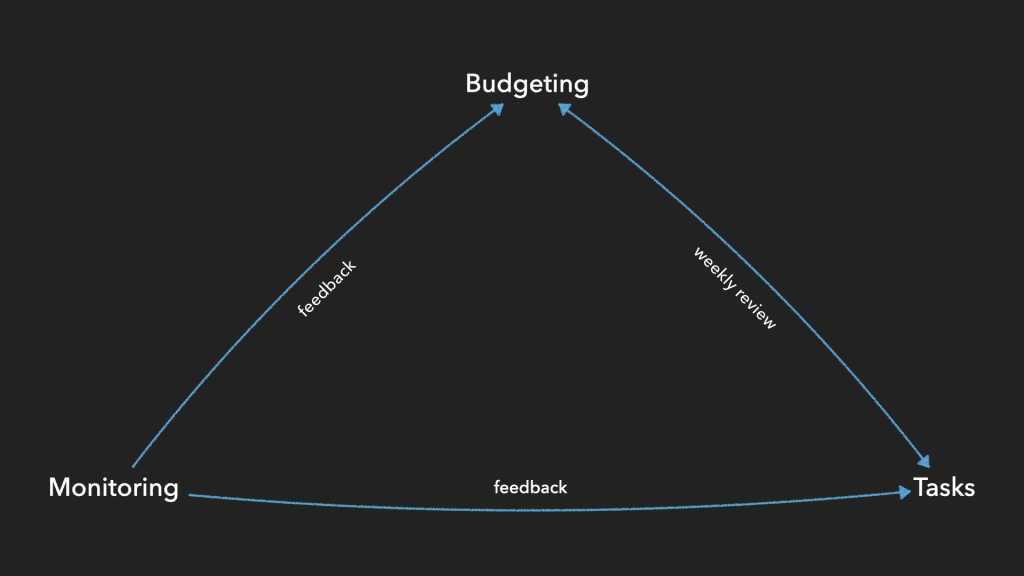
Theory is one thing, practice is another. If your question is Who controls the controllers?, the answer is simple: the controllers. In this case, it’s always you.
You need to ensure that your time is being used effectively, just as you planned.
How so? I have two tips:
- Daily review: At the end of each day, reflect on which tasks were completed, assess productivity, identify areas for improvement, and reschedule any task that was not finished.
- Weekly review: Review the past week’s activities, what has been done? What has actually happened? Is any discrepancy a one-off occurrence, or is a pattern being established? Was I too ambitious, too distracted, or did everything go by plan? It is crucial, during the weekly review, to identify areas for improvement and iterate on them. No system will ever be perfect, but every system can be improved iteratively up to the point of diminishing returns.
- Weekly plan: Plan the tasks for the upcoming week. For me, this means defining the three most important things I want to get done, and allocating enough time to be able to finish them, and consider my week as productive. Subsequently, all my interactions with colleagues take priority, and if I can get more solo tasks done, that’s a bonus, but I won’t be disappointed if not.
After a while, the daily review doesn’t yield much value anymore. Today, I don’t really do them anymore, and limit myself to rescheduling any tasks from that day that I wouldn’t have been able to complete. They were very helpful in the early days to have a higher frequency feedback loop.
Time management is a practice, I have become better at it, and you will too if you dedicate some time and energy.
But I never skip the weekly planning session
That’s the pivotal point of the whole system.
Meanwhile, in Vienna…
When I’m not product managing, I enjoy black and white photography. 🙂
Here is a picture I took recently in Vienna for a series in progress: “Bim.”
“Bim” is how the Viennese call their trams. In addition to software and photography, I also have a passion for trains and trams, particularly the now disappearing ones that have been riding through this beautiful city for the past 50 years.

→ Add me on LinkedIn
Until we meet again…
Thank you for being a Morfternighter. If someone forwarded this to you, you can subscribe. I also write and publish my photos on paolo.blog.
Cheers,

P.S.: If you enjoyed reading this, please don’t hesitate to share it.
Leave a Reply